19.2 Billion Login Attempts, One Quarter, One Message

Security firewalls blocked over 19.2 billion brute force login attempts targeting WordPress sites in Q3 2025. That number is so large it is easy to dismiss as internet background radiation. The problem is that your login page is not a billboard. It is a door. And attackers keep checking if it is unlocked.
Brute-force attacks are blunt, but they often work enough to stay profitable. They lean on password reuse, leaked credentials, and default usernames. If a single admin account gets guessed, the impact is rarely “just a website issue.” It becomes an access issue. For customer-facing WordPress apps, that can mean account takeover paths, injected scripts, defaced pages, payment or lead flow interruptions, and an incident response cycle that pulls engineering time off the roadmap work.
This is where many teams get surprised: your host can provide a secure environment, but it cannot enforce how your application authenticates users. Your risk lives in the gap between infrastructure protection and application controls. Marketing teams feel this later as well, when campaigns slow down, forms stop converting, or trust erodes after a visible security event.
The good news is that brute force is one of the most preventable threats when you treat login as a protected surface. Tight rate limits, smart lockouts, MFA enforcement for privileged roles, and protections against credential stuffing change the economics for attackers. Paired with CDN/WAF configuration, you can push noisy traffic away from origin and keep real users moving.
If you want to reduce this risk without adding friction to legitimate logins, start with a focused hardening plan. Schedule a WordPress Login Lockdown review to identify where brute-force pressure could lead to real access, and close those gaps before your next incident report.
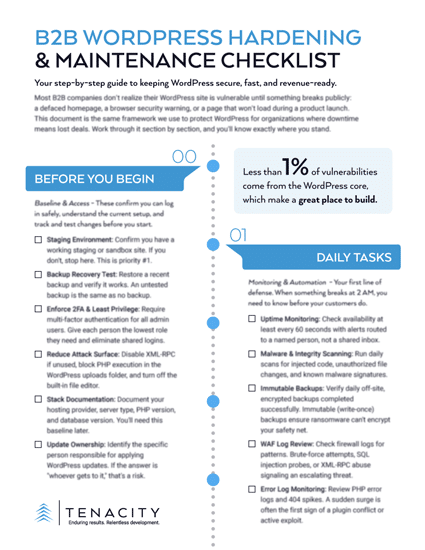
DOWNLOAD THE B2B WORDPRESS SECURITY CHECKLIST