Only 7 Vulnerabilities Traced Back to WordPress Core in 2024

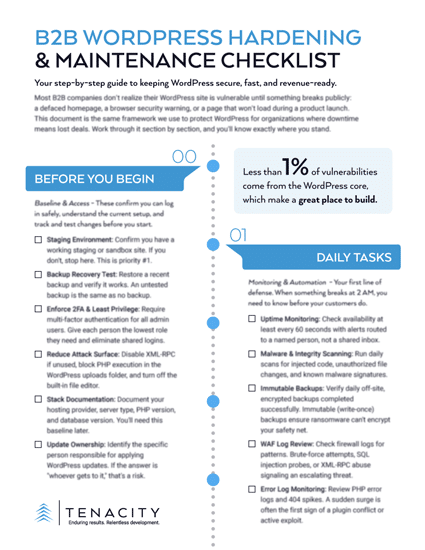
If you’re weighing whether WordPress is “enterprise enough,” security headlines can make the decision feel risky. Here’s a useful counterpoint from 2024: only 7 vulnerabilities were traced back to WordPress core itself.
That number matters because it reframes the real question. For most organizations, the biggest security exposure is not the platform’s foundation. It’s everything layered on top of it: third-party plugins, themes, integrations, and the custom code that accumulates over years of campaigns and feature requests. When something breaks, stakeholders often blame WordPress. In reality, they are seeing the cost of an unmanaged supply chain.
A skeptical platform review usually starts with, “How do we reduce risk?” The practical answer is, “Control what changes and how it gets deployed.” That means fewer unknown dependencies, tighter standards for what can be installed, and a build that treats security as an operating requirement rather than an afterthought. It also means being honest about ownership: who is responsible for updates, monitoring, backups, and incident response when a disclosure drops on a Friday afternoon.
If your team is considering re-platforming, this stat is a reason to slow down and measure the right thing. Moving off WordPress does not automatically reduce risk. It often swaps one set of dependencies for another, plus a migration window in which governance loosens and temporary fixes become permanent.
A better path is to keep the platform, reduce the surface area, and run a site that is built to be maintained. When WordPress core vulnerabilities are this limited, the competitive advantage comes from disciplined implementation and ongoing care, not from starting over.
WordPress isn’t the problem when the foundation stays this stable. The risk is what gets bolted on without standards. Review your WordPress build and we’ll show you where control slips.
DOWNLOAD THE B2B WORDPRESS SECURITY CHECKLIST