4.7 Million WordPress Sites Are Hacked Every Year

Approximately 4.7 million WordPress websites are hacked every year. For a business leader, that stat is less about tech drama and more about probability. If your website drives leads, investor confidence, recruiting, or customer support, a breach is not an IT inconvenience. It is revenue interruption and brand damage on a public stage.
The toughest part is that most compromises do not announce themselves right away. A single injected script can quietly siphon form submissions, redirect paid traffic, or poison SEO for weeks before anyone notices. Marketing teams feel it as the cost per lead creeping up. Sales teams feel it when demo pages time out. Leadership feels it when a partner asks why your domain showed up on a blocklist.
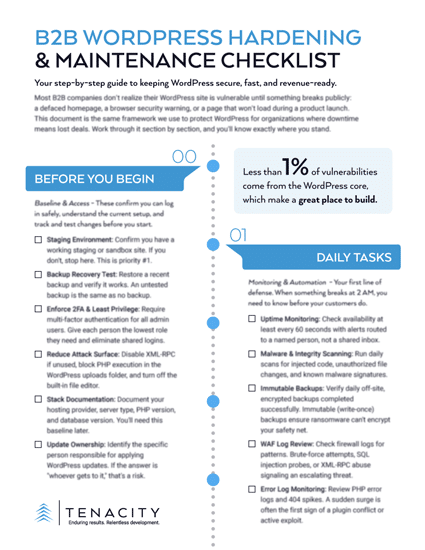
This is why WordPress security risk should be treated like any other operational risk. You reduce exposure by tightening the basics and making the ongoing work repeatable: limit admin access, enforce strong authentication, keep themes and plugins current, and remove anything you are not using. Then add monitoring that catches changes quickly, plus a response plan that defines who does what when something looks wrong.
None of this requires turning your company into a security shop. It requires a guide who can translate risk into a short, prioritized plan and keep that plan running month after month. That is also how you protect the website budget. Prevention is predictable. Cleanup is not.
If you are making decisions based on pipeline and forecasts, the question is simple: do you know your current exposure, and do you have someone accountable for reducing it? A quarterly WordPress Security check is rarely enough because new vulnerabilities keep emerging. Pair hardening with steady maintenance so updates, backups, and log reviews happen on a cadence, not in a panic. That combination turns WordPress security risk into something you can measure, report, and steadily drive down.
This risk is measurable, which is good news. Once you know what is installed, what is exposed, and what is being watched, you can reduce it quickly and keep reducing it over time. That is how you protect revenue and protect the website budget from surprise incident costs. Review your current security posture.
DOWNLOAD THE B2B WORDPRESS SECURITY CHECKLIST