
You have 15 seconds. That’s how long the average visitor stays on a website before deciding whether to explore further or hit the back button. Most businesses use those precious seconds talking about themselves—their awards, history, and impressive client roster. Meanwhile, visitors ask one question: “Can you solve my problem?”
The websites that convert aren’t necessarily the prettiest or most feature-rich. They’re the ones that immediately make visitors feel understood. They do this through a story, but not the story you might expect.
Why Storytelling is Your Website’s Superpower
Think about it: humans are wired for stories. From ancient campfires to binge-watching our favorite shows, narratives captivate us. The same goes for your brand. When you tell your story, you’re not just selling a product or service; you’re inviting people into your world, your mission, and your “why.”
Adobe reports that 67% of consumers prefer brands that tell a story. That’s a huge chunk of your potential audience actively seeking out brands with a narrative! Narrative elements create emotional resonance with users, leading to stronger connections over time. Ultimately, this leads to stronger brand loyalty, better engagement, and a more memorable online experience for your visitors.
The most powerful websites don’t just tell one story; they tell two interconnected stories. Your brand story builds trust and credibility, and your customer story shows the transformation you make possible.
“When we position our customer as the hero and ourselves as the guide, we will be recognized as a trusted resource to help them overcome their challenges.”
— Donald Miller, Building a StoryBrand
It’s all about building that connection. When users feel emotionally invested, they’re more likely to trust you, stick around, and even root for you.
Weaving Your Narrative: For Existing Sites & New Beginnings
Now that you’re convinced that storytelling is the way to go… how do you actually implement it?
Whether you’ve got an established site or you’re just sketching out your first wireframes, here’s how to infuse your website with compelling narratives that serve both your brand story and your customer’s journey:
If You Already Have a Website: Integrate Your Story
No need for a complete overhaul. You can sprinkle storytelling elements throughout your existing site:
- Refine Your “About Us” Page: This isn’t just a place for dry company history. Make it a journey! Talk about your humble beginnings, the challenges you overcame, the passion that drives you, and the people behind the scenes. But remember, your story should answer: “How does knowing our story help you succeed in yours?” Use photos and even short videos to add a personal touch.
- Product/Service Pages with a Twist: Instead of listing features, describe the problem your product solves and the transformation it offers. How does it improve your customers’ lives? Use testimonials and case studies as mini-stories of success.
- Blog for Deeper Dives: Your blog is prime real estate for ongoing storytelling. Share behind-the-scenes glimpses, customer spotlights, industry insights from your unique perspective, and personal anecdotes about your brand’s values. Balance your brand story with customer journey stories. For every post about your process, consider one about a customer’s breakthrough.
- Strategic Calls to Action (CTAs): Instead of “Buy Now,” try CTAs that tie into your story. “Join Our Journey,” “Discover Your Potential,” or “Start Your Transformation Today.”
- Visuals that Speak Volumes: Review your images and videos. Do they align with your brand’s narrative? Use photos that show your process, your team, or the impact of your work.
- User Experience (UX) Flow: Consider a user’s path through your website. Does it feel like a cohesive journey, or just a random collection of pages? Guide them through your story with clear navigation and intuitive design.
“People are telling us what they care about and it isn’t our products. It’s their journey, their story, the meaning they want to create in their lives.”
— Bernadette Jiwa, Difference
Creating a Website from Scratch That Tells a Story:
This is where you get to build your narrative from the ground up!
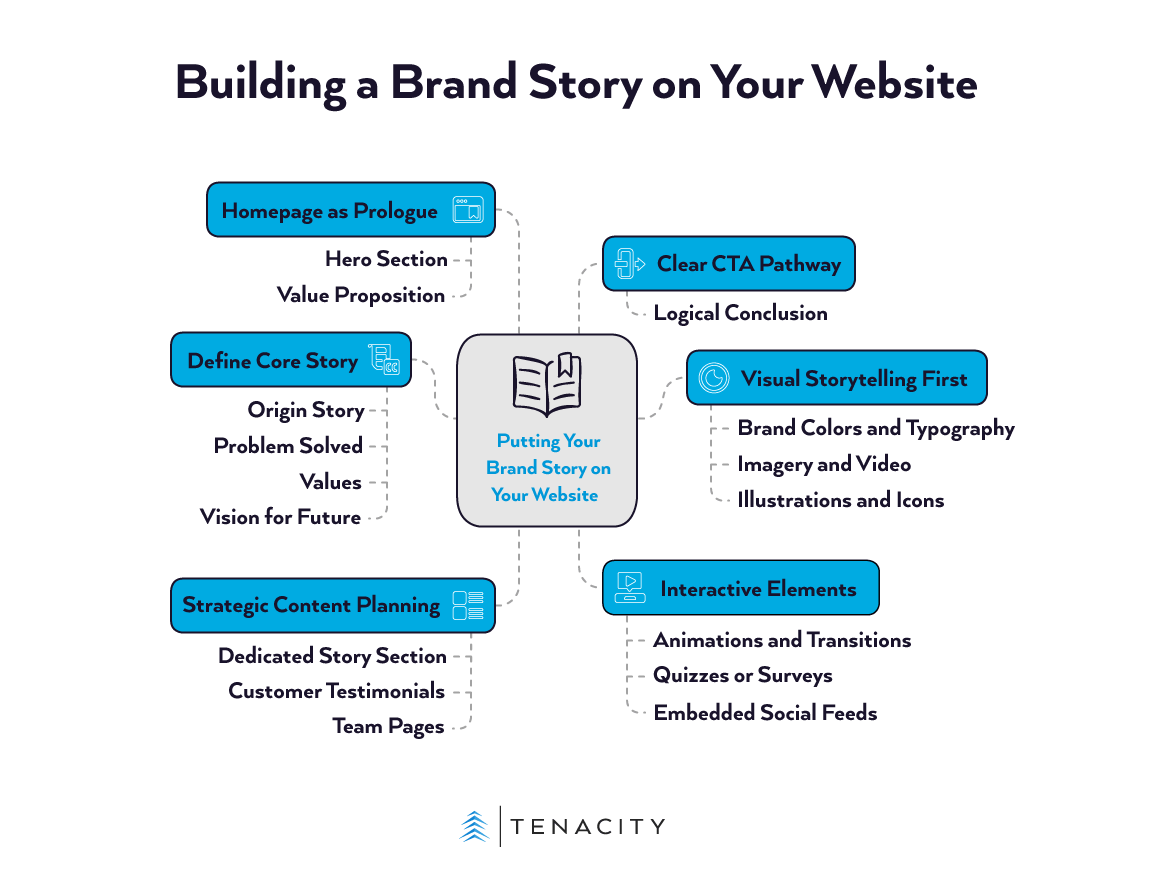
- Define Your Core Story: Before opening your design software, clarify your brand’s central narrative. What’s your origin story? What problem do you solve? What are your values? What’s your vision for the future? Equally important, map the customer journey story: what does your customer’s life look like before they find you? What’s their struggle? How do they feel after you’ve helped them?
- Homepage as Your Prologue: Your homepage is the opening chapter of your story. Use a strong headline, compelling imagery, and concise copy to immediately convey your brand’s essence and what makes you unique.
- Hero Section: This is your big, captivating intro. Think about using a striking image or video that immediately hints at your story.
- Value Proposition: State what you offer and why it matters, tying it back to your core narrative.
- Visual Storytelling First: Design with your story in mind.
- Brand Colors and Typography: These aren’t just aesthetic choices; they evoke emotions and set the tone for your narrative.
- Imagery and Video: Invest in high-quality, authentic visuals that communicate your brand’s personality and values. Show, don’t just tell!
- Illustrations and Icons: Custom illustrations can add a unique visual language to your story.
- Strategic Content Planning: Every piece of content should contribute to your overarching narrative.
- Dedicated Story Section: Consider creating a prominent “Our Story” or “Our Mission” section that provides in-depth details about your brand’s journey.
- Customer Testimonials/Case Studies: Integrate these powerfully. They’re real-world examples of your story in action.
- Team Pages: Introduce the people behind your brand. Humanizing your team makes your story more relatable and approachable.
- Interactive Elements: Engage your audience in your story.
- Animations and Transitions: Subtle animations can guide the user’s eye and add to the narrative flow.
- Quizzes or Surveys: Engage users and gain deeper insights into their experiences.
- Embedded Social Feeds: Show your ongoing story as it unfolds in real-time.
- Clear Call-to-Action (CTA) Pathway: Guide users through your story and clearly indicate the next step to take. What’s the logical conclusion to their journey on your site?
“Marketing is the generous act of helping others become who they seek to become. It involves creating honest stories—stories that resonate and spread.”
— Seth Godin, This is Marketing
How Brand Story and Customer Story Work Together
We’ve talked about weaving both stories throughout your website, but how do they actually complement each other? Here’s how to strategically deploy each narrative:
- Understand Their Different Purposes: Your brand story builds trust and credibility—it answers “Why should I believe you can help me?” Your customer story drives action and conversion—it answers “What’s possible for me?”
- Map Stories to Website Sections: Different pages serve different narrative purposes.
- Homepage Hero: Lead with customer story (their problem + your solution)
- About Page: Primarily brand story, but always connect it back to customer value
- Service/Product Pages: Customer transformation with brand credibility woven in
- Testimonials/Case Studies: Customer stories that reinforce your brand story
- Create Strategic Intersections: The magic happens where these stories meet.
- Show how your brand values directly benefit customer outcomes
- Use customer success stories to demonstrate your expertise
- Let your origin story explain why you’re uniquely positioned to help
- Maintain Consistent Messaging: Both stories should reinforce the same core themes.
- Your brand story should explain why you care about customer problems
- Customer stories should reflect the values and quality your brand represents
- Balance the Mix: Don’t let one story overshadow the other.
- Blog Content: Mix behind-the-scenes brand moments with customer success features
- Social Proof: Use testimonials that highlight both customer results and your approach
- Visual Content: Show your team in action helping customers achieve their goals
When these stories intersect seamlessly, visitors don’t just understand what you do—they envision what becomes possible when they work with you.
“Stories are the currency of human relationships.”
— Robert McKee, Story
Quick Story Audit: 5 Questions Every Website Should Answer
Before you publish, run through this simple checklist:
- Problem Clarity: Does our homepage clearly convey what problem we solve for our customers?
- Transformation Promise: Can visitors easily understand what’s possible when they work with us?
- Hero Positioning: Do our stories make customers the hero of their journey?
- Proof Points: Do we show real examples of customer success and transformation?
- Consistent Narrative: Is our story consistent across all pages, or does it feel disjointed?
If you can confidently answer “yes” to all five, your website tells a compelling story that connects and converts.
The Takeaway
Your website is more than just code and content; it’s an opportunity to connect with your audience on a deeper, more meaningful level. By embracing the power of storytelling, both your brand’s story and your customers’ journeys, you can transform your website from a passive information hub into an engaging experience that builds trust, fosters loyalty, and truly resonates with your users.
The most powerful websites don’t just tell one story; they tell two interconnected stories that work together. Your brand story establishes credibility, while your customer story shows transformation and possibility. When these narratives intersect seamlessly on your website, that’s when real connection happens.
So go ahead, let your brand’s story shine while making your customers the hero of their own! And if you need help, contact us—we’re ready to help you bring your website to its full potential.
Sources:
- Telling Your Story: How to Make Your About Page Stand Out | Vervology®
- Hidden UX Patterns That Make Websites 10x More Effective in 2025 | Netguru
- Does Your Website Tell Your Story? | AndiSites Inc.
- How to Structure Web Content to Tell as Story | Brave Factor
- The Ultimate Guide to Tell Your Brand Story (Plus Examples) | Column Five Media